
Reflections on Singapore Minstrel, ten years on
Clown but not out

The first time I saw Singapore Minstrel was in 2016, when it premiered at the Asian American International Film Festival. I was interning at the festival in New York City, unpaid but especially optimistic as I continued to undertake my Film Studies like it would be my life. In many ways it has been and continues to be, but not in the way I would have envisioned back then.
While watching the screener of Singapore Minstrel, probably on my laptop while crashing in my friend’s New York City apartment ten years ago, it felt like a message from home meant for me. I remember squatting in the front of a cinema tending a Skype (rip) video call with Salty Ng for the Q&A of the film. Speaking to a kindred spirit in the context of the festival, halfway around the world, was probably a source of warmth.
The contents of that Q&A are forgotten, but the film still surfaced in my memory as a colourful haze of love, for the subjects within it, for the Singapore I recognised but had not given myself the permission to shape in the way Roy and his compatriots have. Watching these buskers do what they love for artistic expression and for livelihood seemed like a promise that, no matter how difficult “the art life” would be, it could be worthy: worth spending a life on, and worth a few coffers in the basket at least. The film felt like a love letter.
Ng’s approach to her “fantasy documentary”, with its whimsical asides that re-enact Roy’s past, was also not the stodgy realist documentary you might expect from Singapore. It reflected and amplified artistic joy, both from its subjects and from Ng herself. Through silent mime sequences, colourful sets, and slice of life vertical video, it depicted Roy’s internal life and personal history with a truth that unadorned presentation would not have been able to.
Even with its predilection toward flights of fancy, it also found the time to depict the conditions of busking and its regulation in Singapore with piercing clarity, that put the Singaporean state’s tendency for bureaucracy, alignment, and pointless jargon on notice.
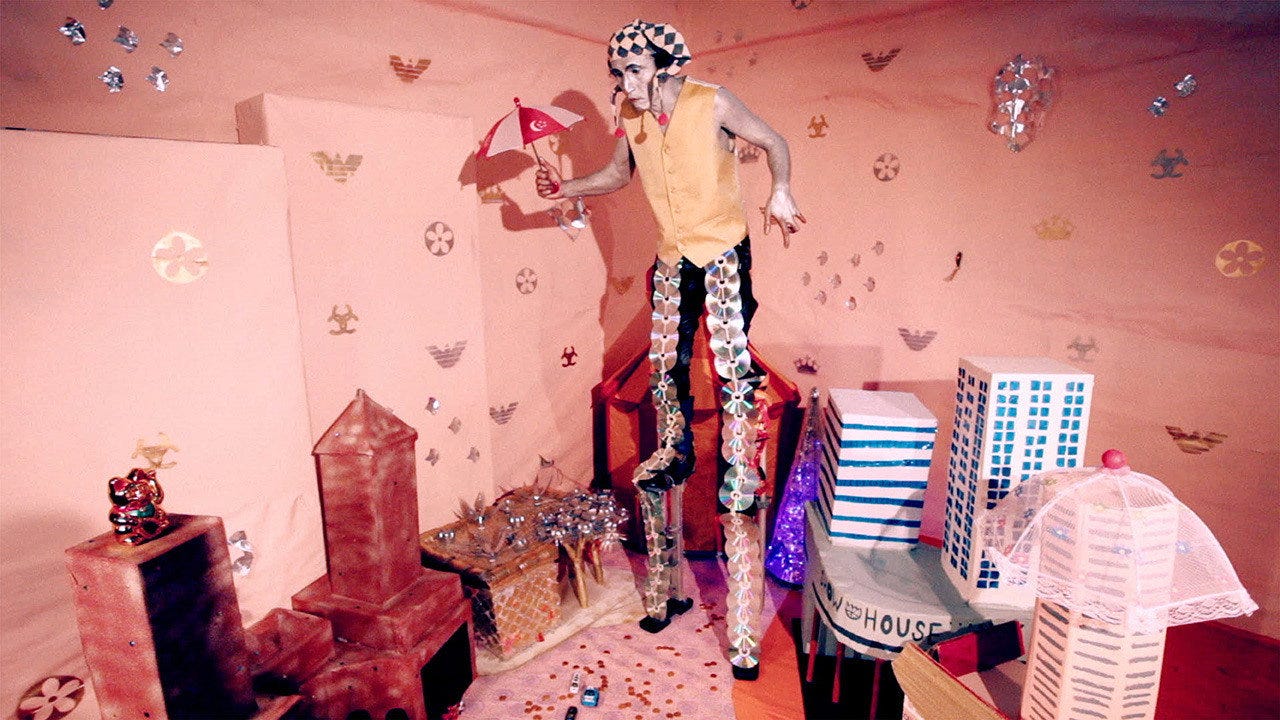
A career in film didn’t really feel so far-fetched then. It felt like if Ng could make a film like this, if someone like Roy could live like this, in a Singapore like this, that there was hope. That maybe one could find their own way in Singapore, even if they were not one of the state’s few anointed artists.
Now, the film finds me again, ten years later. I am more jaded, more cynical, more uncertain. I’ve worked in (and largely left) the film industry, and have seen the bitterness, complacency, and envy that surfaces both in myself and others. I see the stupidity of bureaucracy at every level whether in art or outside of it. It runs so deep, it installs itself in your own mind: I find myself climbing imaginary ladders and constraining myself to lanes that everyone says must be followed but no one can actually see.
In the ten years since, Singapore has changed, as restlessly as it always has, becoming more like the Singapore we imagine it is supposed to be. We find ourselves always falling short of new ideals that others are foisting upon us. The pressures may feel external, but this is the Singapore of our own design. Why is the Singapore that is meant to be, never the Singapore that’s meant for us?
If anything, the film feels more salient today than in 2016. Impracticalities are now painted as impossibilities. While the country as a whole attempts to embrace diversity in myriad domains, it feels like our psychological terrain has narrowed. When you run these tracks over and over, the indentations in the dirt might start to seem like pavement. Have we become more singular as a people? Does that make us stronger or weaker as a population? Sometimes, even our rebellion can feel cookie-cutter.
“If you were good, you wouldn’t be here.”
The above is uttered by a judge at an audition briefing for prospective buskers in the film looking to score a licence. As if being or becoming good is the only purpose of art. That “good” only gets defined from recognition. That “recognition” only comes from advancing upwards toward larger and more prestigious stages.
I hear from Roy after the movie of his current busking exploits, a juggling act set to music, that is still the expression of how he imagines his life must be. Is this juggling act better or worse than his more involved silver statue performance? Does it matter?
I’ve realised recently that I had wanted to work in film for the wrong reasons. That is, wanting to prove something, whether it be skill or intelligence, and that I could “beat” others at this game and finally show my worth. As I get older, I have realised that these games are make-believe; there is only desire and action. I find the worst thing in life is to be playing games other people have told you to play; forced into action for the desire of others.
“If you could have freedom, would you take it?”
Roy asks us this in a talking head in the film. It is the most pertinent question of the film to me. Despite all the hemming and hawing about what we can and cannot do in this country, there are still many ways we can exercise our freedom of choice. We are free to be free, but will the mind allow it? Growing older seems to be the gradual installation of more restrictions on the self. What happens when the most important creative choices in your life are the walls you choose to put up?
Revisiting the film, I did not remember the scenes in which Roy’s frustration is patently palpable. Yes, the film is a love letter, but one laced with regret, anger, and bitterness. Even as old haunts get swept away, free spirits still want to feel like they belong somewhere. We might all be born and raised here, but some can be said to be more Singaporean than others. The sad jester is a common fixture in our imaginations because the trade-off is apparent. To live freely, without reservation, and against the grain is to frequently choose loneliness. Freedom comes with strings attached. Even for those that choose their own paths, they can lead nowhere.
Would you believe me, after all of the above, that I remain as optimistic as I’ve ever been about the future of art-making in Singapore? Arguably, it is the part of me that is most Singaporean; putting this much stock in the future. We are always spending (squandering?) the present to invest in the future. Today is never enough, because the future always holds more promise.
I imagine it always has to, because hope is free.
These days I ask myself simpler questions when it comes to creative work: How do I find creativity in the everyday? How much grace can I extend to others and myself? How much energy can I expend in showing up for my friends? What joys can be had when you stop looking for more and ask for less? While I might ruminate on the future, it is best to first ask: what can I do today?
I believe we should all choose freedom, even if it is frightening, because it leaves room for hope. This is not a recommendation I give lightly, because I lied: the cost of hope is future disappointment, and one must decide how much they are willing to take.
Watching the film again, I realise it has found me again as I tap into new founts of creativity and try to unearth myself from the weight of expired expectations. I am so grateful for it. When previously it felt like the film gave me some semblance of aspirational hope, today it reminds me I’ve never let that hope go: the path forward might be shrouded in fog, but I can still walk.
Notes
There’s at least one more screening of this in Singapore for the 10th anniversary of the film at Filmhouse as of today, get tickets! Maybe if we get it to sell out again, we can convince them of a proper run of this film. It’s vastly under-seen in Singapore, and I think it might be the best film about Singapore by way of lived experiences that seem atypical for Singapore. I highly recommend it (if it was not already obvious)!
Yes, it’s been a long time since I’ve written. There are scraps of half-written pieces, essay ideas, and the like all over for me. It seems I’m always in a tense relationship with my film writing/criticism. Are these ideas worth space here, or better relegated to the “disposable” nature of Letterboxd? There’s a feeling like I have a “duty” to write more regularly, but these days I rather wait for the desire to write to possess me. While writing is largely still a self-elected mode of suffering, a piece like this announces its need to exist, and I find myself submitting to it. Are we creative agents, or merely conduits? Muses, speak to me, I’m listening.