
The spirits in the medium
The experimental films of Richard Tuohy and Diana Barrie

I’ve struggled in the past with making sense of experimental film. Do they offer a pure sensory experience or something intellectually argumentative? As someone who usually looks for an emotional experience in the cinema, formally experimental cinema, especially the likes of which I’m writing about here, is not usually something I find myself sinking into. Additionally, being in the dark of the cinema also taps into some primal circadian rhythm that sends me off to dreamland, that is unless there’s some narrative hook from the flickering silver screen to keep me engrossed.
I’d not really expected to be taken by experimental films like this but sometimes the universe brings gifts.
Back in October, Film Nerve organised a night of experimental films made by Richard Tuohy and Dianna Barrie, entirely screened on a good ol’ whirring 16mm projector in the Black Box at Centre 42. Tuohy and Barrie were in attendance, projecting the films for us, and guiding us along their experimental approach.
In between films, Tuohy would go to the front of the makeshift theatre, his headlamp still on, describing the following film, while Barrie prepared the next film for projection. The physicality of the projection created a ritualistic mode for the presentation.. It is almost as if Tuohy must speak in between films so that we would not be sitting in silent darkness, and that he acted as spirit guide into a flickering world that first needed tending to. Moreover, his commentary gave useful context as to the making of each film, and the structural concepts that underpin them. Especially for someone who might only dabble in viewing experimental films, these explanations oriented me toward the patterns and sensations to look out for as I watched these films.
(I am reminded, of course, of Chantal Akerman, whose structuralist approach creates films that look and feel the way they do.)
When we moved from analog to digital filmmaking and projection, we lost a physical connection to the medium. Analog film was elemental, literally— the effects of chemical processes that created regions of light and dark on filmic elements. And, as in nature, there’s also unpredictability in the means of capturing, film processing, and projection.
Some of the films in the programme are “camera-less” in that the film sequences are created using chemical processing rather than subjecting the films to reality as shown through a lens. Using some sort of structural principle, the film elements are processed unconventionally to create moving shapes that turn into mesmerising sequences. Far from random, given Tuohy and Barrie’s experience in the chemical processing of film, they form patterns that cement and then contort. While they lack a narrative, they do feature arcs that can be sensed even if they are difficult to explain.
Tuohy and Barrie are intensely enamored by the way that the moving image tricks the brain into creating movement and feeling. These unconventional structural guidelines and chemical processes that they subject their film elements to are another approach to creating this illusion. Even the term “moving image” is itself a lie because the image does not move. It is always a series of still images flickering so rapidly that your mind stitches them together as if they were a singular object in motion.
Even with digital projection or screens of all resolutions, these illusions operate similarly. The moving image is still magic, and somehow, this night of films felt like a renewed cinematic awakening. Below are my descriptions and reflections on some of these films.
The films
Tooborac
Of the seven films we saw, I was most taken by Tooborac which features gigantic granite boulders, sometimes balancing on other stone plateaus, in the landscape of Tooborac, Australia (see: tor). The film is made in a “stop-motion” style, that is filmed frame by frame, where the camera whips around these boulders in a circular motion, always center-framing the boulder, sometimes moving in closer, but at immense speed.
Thinking back on the film now, the experience of viewing is so different from the act of making it, which must have been slow and laborious as the camera is moved from one position to another for every frame. As the film progresses, a sort of a circular fresnel-like filter is placed in front of the lens, distorting the shapes of the boulders. The effect of this filter is that it feels like we are peering through the boulder, seeing the sky behind them. The combination of the camera’s illusionary high-speed movement, camera effects and intense music creates an experience that feels like we are communing with the Earth, moving at the speed of its revolutions and able to penetrate and split its formidable landscapes with sight itself. This was wildly hypnotic, and awe-inspiring, befitting the subjects at its centre.
The Land at Night
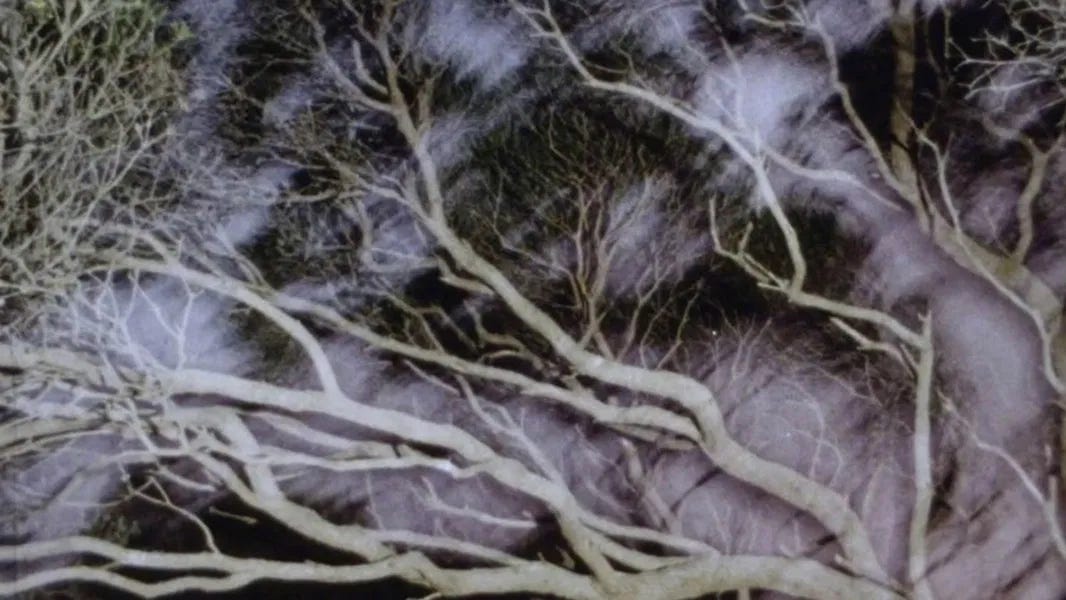
Another film that lodged in my mind was The Land at Night, which for me felt almost like a horror film. The film moves rapidly, like Tooborac, with each frame taken individually in a natural landscape that is only illuminated with a flashgun. Tuohy notes that the flashgun creates an artificial quality to the images, and is also typically used in stills rather than in moving images. The camera moves through the Australian bush, showing tall grass, trees, leaves, and other natural elements as if one were flying through the bush in the dark with a flickering light. Tuohy “warns” us that there are human elements in the film, which show up as flash illuminations of a person’s hand as they move through the landscape. What he did not warn us of was the abandoned house the camera begins to explore, with disused chairs, run down walls and faulty cupboards which immediately gave rise to an eerie quality. Is the house haunted, or are we the ghost?
The movement through the landscape and the house and the subject of a person’s hand, give the film a “first-person” quality, which is further amplified by the starkly directional light from the flashgun. It feels like the only things that are illuminated are the things that we are perceiving, which creates a sort of psychological vignette. It reminded me of videogames, so-called “walking simulators”, in which one is typically moving through an empty house and picking up the narrative from objects left around the house. While many of these games might not even feature scares, the starkness of an uninhabited room with the remnants of human activity conjures ghosts that aren’t even there, and it functions similarly here.
Camera-less films: Fear of Floating | The Last Train
Of the camera-less films (although I might be classifying them incorrectly), the most affecting for me was Fear of Floating which features footage of a boat crossing in Mumbai shot on expired film that is then processed in a way that creates tendrils of light and dark on the footage. The expired film shows the boat crossing with immense fuzziness, where there are only impressions of silhouettes of boats, of people riding those boats, and sometimes of birds flying overhead. Coupled with watery sound effects, it’s a disconcerting film overall, as if one were thinking of a boat crossing, rather than being on one.
Another film that uses found footage is The Last Train that utilises deteriorated found footage from an old movie trailer from an old Indonesian propaganda film found in archive and then chemically reprocesses it. The film is processed such that the film’s own perforations form imprints onto the image, creating moving rectangles across the frame that leave a ghostly trail. Have you ever stood in an empty train wherein you can see straight through from one end to the other? When you observe the train as it follows gradual curves on the track, you see how the vertical grab handles begin to misalign in succession, and then find linearity again as the track straightens out. With its title, the mechanical movement of the rectangles, and the sound of trains, the film evokes this same sensation with its click-clackety rhythm.
Intermittently, we are shown snippets from the trailer that can sometimes barely be made out, which I can only recall being somewhat sinister or insidious in atmosphere. I guess the question is, where is the train going? Is it the last train of the night, or the last train you’ll ever ride?
China Not China
The thesis of this film feels obvious when you read its title and description: multiple exposures of streetscapes in Taiwan and Hong Kong edited together, both places that are not China and yet China and our atlases claim to be. Slow pans across city scenes are done handheld, repeatedly, and then superimposed, creating ephemeral impressions where city features don’t quite line up and the image is speckled with the bright spots of streetlights and vehicle headlights. Maybe in capturing these cities in this way and then juxtaposing them in the same film, it is portraying their changing natures with definitions unfixed and under threat. Or maybe, I just thought it looked really cool so I’m telling you about it here.
Closing
I think language can only fail to capture the sensations we felt as a collective watching these films, hypnotized and transfixed by these moving images, but I hope these attempts give you a sense of these, even without a single accompanying photo (edit: I’ve since added one photo). I can’t say the films have necessarily increased my appetite for seeking out the experimental, but they have at least expanded my capacity to receive them.
Films in the Programme
For documentation sake, here is the list of seven films in the programme, in the order they were shown:
Notes / Updates
This sat on the backburner for a while, largely written, but I’m glad I managed to come back to send it. A lot has happened since my last piece on The Projector closing. I covered the 38th Tokyo International Film Festival for Deep Cut (with a dispatch episode, and two interviews), and we’ve also covered the 36th Singapore International Film Festival, where we just released our dispatch episode. I don’t think I’ll be writing festival write-ups for either festival, so do listen to the podcast if you’re interested in my thoughts.
For SGIFF, I also wrote for Sasha and Tracey’s Correspondence publication, The Daily. If you’re a new subscriber because of my piece, I hope you enjoy what I’m writing here. I got a great response for this piece, mostly in-person, which was lovely. I’m really glad people are engaging with the festival through the writing in The Daily. It signals that we have the capacity to engage with cinema and its surrounding culture and institutions in a deep and critical way in Singapore, and that we do have an audience for such writing or commentary. I love what Sasha and Tracey have done with The Daily, contributing greatly to the vibrancy of this year’s festival with a ground-up spirit, and can’t wait to see what else they cook up under the Correspondence umbrella. It makes me really hopeful for cinema culture in Singapore (not to forget what the FFIGS team is also doing), and I think it shows we can make the culture we want to see without large institutional backing. We can always start small, there’s always you and me.
Also, since I last wrote, I’ve launched filmbulletin.sg, which aggregates film listings outside the mainstream cineplex circuit in Singapore, including smaller film festivals and screenings from institutions like Asian Film Archive and Objectifs. If you’re in Singapore, I hope you find it useful, and do share with others! If you’re someone organising film screenings, especially something like what Film Nerve have done for this event I wrote about here, do reach out if you’d like to list!
Until the next one (maybe next year?)
— Ben